|
|
Dr. Jiye Fang's Nano Research Group |


Topological insulators (TIs), such as Bi2Te3 and Bi2Se3, represent an emerging class of quantum materials with unusual electronic properties. In these materials, strong spin-orbit coupling causes an inversion of the conduction and valence band states. As a result, TIs behave as electrical insulators in the bulk while supporting highly conductive electronic states on their surfaces or edges. These surface states are protected by symmetry and exhibit spin-momentum locking, making them robust against scattering and defects.
Two-dimensional (2D) topological insulators are particularly interesting because their layered structures can host helical metallic edge states surrounding an insulating interior. These unique electronic states provide a platform for exploring exotic quantum phenomena, including the quantum anomalous Hall effect (QAHE). Unlike the conventional quantum Hall effect, QAHE can occur without an external magnetic field, making it highly attractive for next-generation low-power electronics, spintronics, and quantum computing technologies.
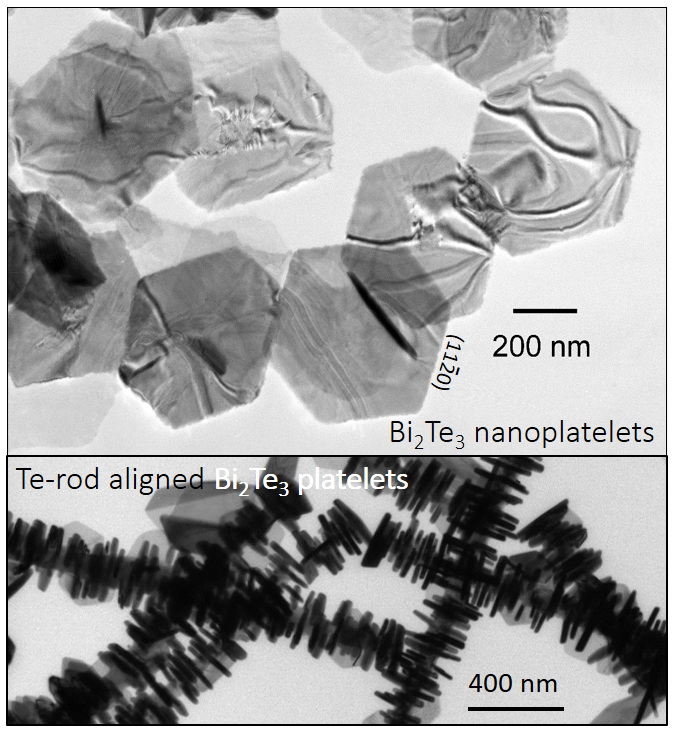
Our research focuses on the development of Bi2Te3-based two-dimensional topological insulators, particularly tetradymite-type layered compounds. Using advanced wet-chemical synthesis methods, we aim to precisely control the composition, crystal structure, and dimensionality of these materials in order to enhance their electronic and magnetic properties.
In collaboration with partner research groups, we are exploring natural heterostructures in which topological insulator layers intergrow with magnetic layers that exhibit intralayer ferromagnetism and interlayer antiferromagnetism. These hybrid structures provide an effective route for introducing magnetic order into topological materials without the need for external magnetic fields. By engineering such coupled magnetic-topological systems, our goal is to increase the critical temperature for the quantum anomalous Hall effect, enabling more practical experimental observation and potential device applications. This project contributes to the broader effort to design and create functional quantum materials that could serve as building blocks for future quantum electronic and spintronic devices.
Further reading materials:
J. Phys. Chem. Lett., 8(8) 1905 - 1919 (2017).
J. Am. Chem. Soc., 127(28) 10112 - 10116 (2005).
Binghamton University
· Chemistry
Department · 25 Murray Hill Road · Vestal, NY 13850
Materials on this website may only be browsed and saved for personal use.
Please do not reproduce and distribute commercially without permission from
the publisher or website owner.
 Meeting Schedule
Weekly Picks
Research Training
Shared Resources
Chemical Inventory
Presentation Archive
BU Brain
Chem Stockroom
Internal Site
MyBinghamton Group Posters Team Updates Joining our Lab
Campus Map
Campus Parking Info
Meeting Schedule
Weekly Picks
Research Training
Shared Resources
Chemical Inventory
Presentation Archive
BU Brain
Chem Stockroom
Internal Site
MyBinghamton Group Posters Team Updates Joining our Lab
Campus Map
Campus Parking Info|
|
||
 |
 |