|
|
Dr. Jiye Fang's Nano Research Group |


In noble metal nanocrystals (NCs), lattice strain can significantly influence catalytic performance by modifying the electronic structure of the material. In particular, lattice contraction often leads to a downshift of the d-band center, which weakens the adsorption strength of reaction intermediates on catalyst surfaces. This electronic tuning provides an effective strategy for optimizing catalytic activity and selectivity.
Bimetallic NCs are especially promising electrocatalysts because their performance can be tuned through several synergistic surface effects, including the ligand effect, ensemble effect, and strain effect. Among these, strain-induced surface modification plays a key role in regulating the interaction between surface active sites and reactants or reaction intermediates. By carefully controlling structural parameters, such as particle morphology, size, shell thickness, surface defects, and composition, it is possible to engineer lattice strain and thereby enhance the electrochemical performance of these nanomaterials.
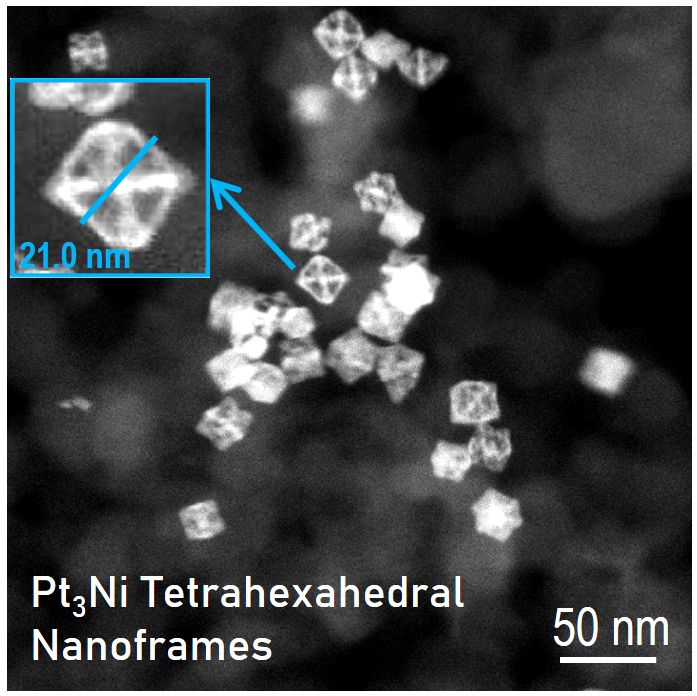
The goal of this project is to advance the development of strain-engineered catalytic sites using a variety of state-of-the-art noble metal nanocrystals as model systems. One effective approach involves creating lattice-stressed structures through the dealloying of binary nanoalloys, which can produce surface-strained catalysts with enhanced activity.
These strain-engineered nanocrystals are being investigated for a range of important electrochemical reactions, including the oxygen reduction reaction (ORR) in fuel cells, the hydrogen evolution reaction (HER) and oxygen evolution reaction (OER) in water splitting, and the electrochemical CO2 reduction reaction (eCO2RR). Understanding and controlling lattice strain in these nanoscale catalysts provides a powerful pathway for designing next-generation electrocatalysts with improved efficiency, stability, and selectivity.
Further reading materials:
Nano Lett., 23 (8) 3476 - 3483 (2023).
Nat. Mater., 25 (3) 447 - 455 (2026).
Binghamton University
· Chemistry
Department · 25 Murray Hill Road · Vestal, NY 13850
Materials on this website may only be browsed and saved for personal use.
Please do not reproduce and distribute commercially without permission from
the publisher or website owner.
 Meeting Schedule
Weekly Picks
Research Training
Shared Resources
Chemical Inventory
Presentation Archive
BU Brain
Chem Stockroom
Internal Site
MyBinghamton Group Posters Team Updates Joining our Lab
Campus Map
Campus Parking Info
Meeting Schedule
Weekly Picks
Research Training
Shared Resources
Chemical Inventory
Presentation Archive
BU Brain
Chem Stockroom
Internal Site
MyBinghamton Group Posters Team Updates Joining our Lab
Campus Map
Campus Parking Info|
|
||
 |
 |