|
|
Dr. Jiye Fang's Nano Research Group |


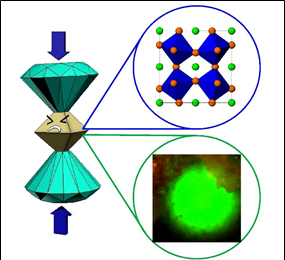
The properties of materials can change dramatically under pressure. Because the electronic band structure is closely related to chemical bonding, it is highly sensitive to pressure and structural distortion. These effects can be introduced either through internal stress, generated by modifying relative ionic sizes, or through external stimuli, such as applied strain or hydrostatic pressure. Pressure therefore provides a powerful tool for tuning the structural and electronic properties of materials.
Using high-pressure techniques, our research focuses on two major classes of materials: semiconductor quantum dots and hybrid perovskite materials.
(1) Semiconductor quantum dots. Our studies revealed that the semiconductor PbTe can form a high-pressure-tuned metastable structure that can be retained under ambient conditions. This work demonstrated, for the first time, a reversal of the well-known Hall-Petch relation, linking structural stability to particle size (DOI: 10.1021/nl203409s). These findings suggest that PbTe nanomaterials may offer new opportunities for technological applications, including thermoelectronics and energy conversion.
(2) Hybrid perovskite materials. We have also investigated the pressure-dependent structural and electronic properties of hybrid perovskites, which are among the most promising materials for next-generation photovoltaic devices. Through collaborations with research groups at NTU and Caltech, we observed pressure-induced crystallographic phase transitions and band-gap tuning in MAPbI3 (MA = methylammonium) (DOI: 10.1002/adma.201705017; 10.1002/anie.201601788). Our subsequent work further explored pressure effects in FAPbI3 (FA = formamidinium) (DOI: 10.1021/jacs.8b09316). Because pressure-induced band-gap variations strongly influence photovoltaic power conversion efficiency, even modest pressure can trigger structural phase changes and band-gap adjustments when hybrid perovskite compositions are appropriately engineered. This combined chemical-pressure strategy offers a promising pathway for designing new perovskite materials with improved performance in photovoltaic applications.
Further reading materials:
Nano Lett., 11(12) 5531 - 5536 (2011).
Nanoscale, 8(9) 5214 - 5218 (2016).
Nano Lett., 13(8) 3729 - 3735 (2013).
Angew. Chem. Int. Ed., 55(22) 6540 - 6544 (2016).
Adv. Mater., 30(2) 1705017 (2017).
J. Am. Chem. Soc., 140(42) 13952-13957 (2018).
J. Am. Chem. Soc., 141(3) 1235 - 1241, (2019).
Binghamton University
· Chemistry
Department · 25 Murray Hill Road · Vestal, NY 13850
Materials on this website may only be browsed and saved for personal use.
Please do not reproduce and distribute commercially without permission from
the publisher or website owner.
 Meeting Schedule
Weekly Picks
Research Training
Shared Resources
Chemical Inventory
Presentation Archive
BU Brain
Chem Stockroom
Internal Site
MyBinghamton Group Posters Team Updates Joining our Lab
Campus Map
Campus Parking Info
Meeting Schedule
Weekly Picks
Research Training
Shared Resources
Chemical Inventory
Presentation Archive
BU Brain
Chem Stockroom
Internal Site
MyBinghamton Group Posters Team Updates Joining our Lab
Campus Map
Campus Parking Info|
|
||
 |
 |